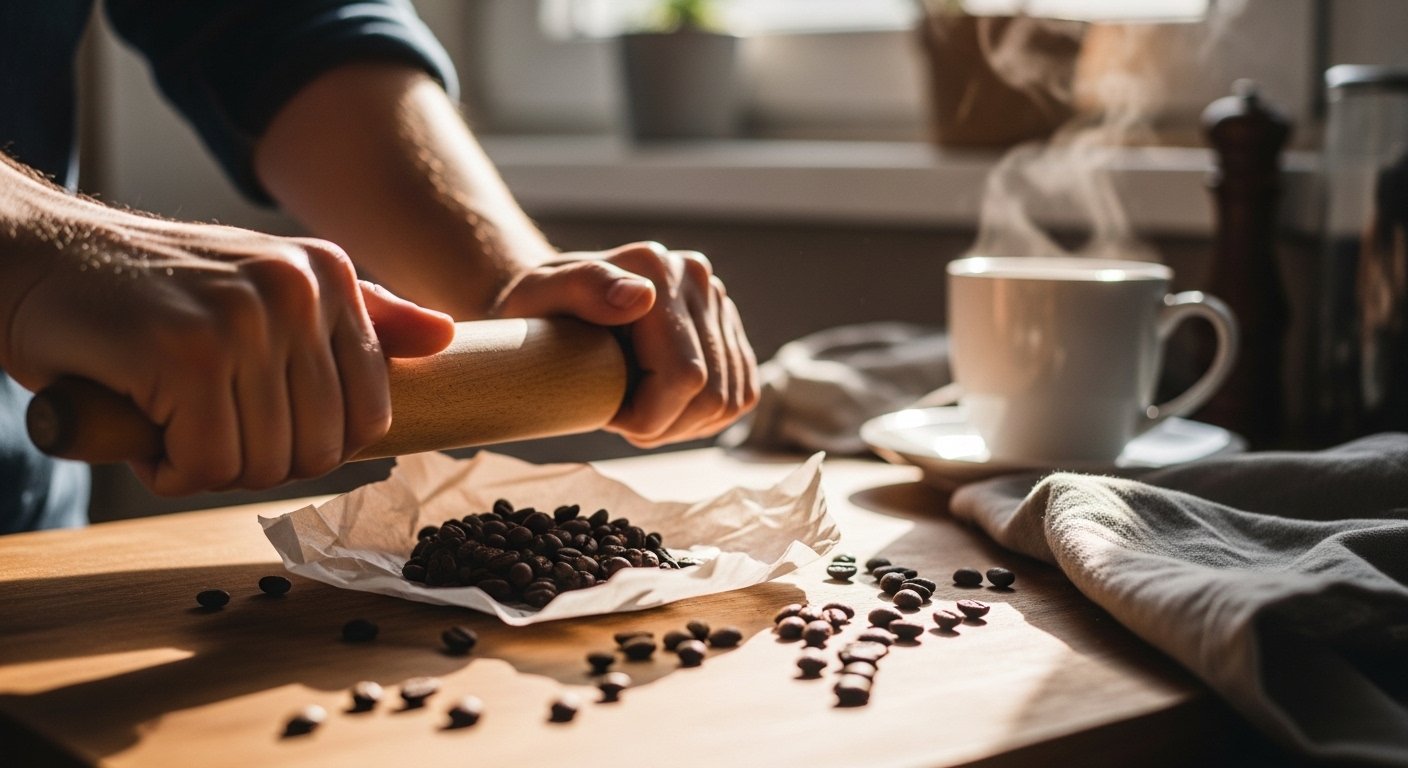
You probably googled how to grind coffee beans without grinder while staring at a bag of whole beans and feeling just a tiny bit betrayed by life, yeah? Like, you have coffee… but also kinda don’t. That weird limbo. And now you’re wondering if smashing them with something is… allowed. It is. Mostly.
Let’s get into it, but not in that robotic “step 1, step 2” way. More like how a friend would tell you while half-asleep and holding a mug.
Why You Even Need to Grind Coffee Beans (and why whole beans won’t just cooperate)
So here’s the thing, whole coffee beans look harmless, but they’re kinda stubborn little rocks. Water can’t really extract flavor from them properly unless they’re broken down. That’s just how extraction works — surface area matters, even if it sounds a bit science-y.
A study published in the Journal of Food Engineering mentions that grind size directly affects extraction efficiency, which basically means: no grind = sad, weak coffee.
Also, chewing them? Please don’t. You can, but… don’t.
What Happens If You Don’t Have a Grinder
Honestly, nothing dramatic happens. You just improvise like humans always have. People were grinding stuff way before electric grinders existed. Mortars, stones, random kitchen chaos — all fair game.
But yeah, the grind won’t be perfect. You’ll get uneven bits. Some powder, some chunks. Coffee purists might sigh loudly, but your caffeine doesn’t care.
Methods: How to Grind Coffee Beans Without a Grinder
1. Using a Blender (probably the easiest cheat)
If you’ve got a blender, you’re already halfway saved.
How to do it:
- Add small batches of beans (don’t overfill, or it gets weirdly uneven)
- Use short pulses instead of continuous blending
- Shake the blender slightly between pulses
The pulse thing matters. If you just let it run, you’ll end up with powder on top and big chunks hiding underneath like they’re avoiding responsibility.
Best for:
- Medium to coarse grind (French press-ish vibes)
Not great for:
- Espresso. Just… no.
2. Food Processor (the chaotic cousin of the blender)
A food processor works kinda similar, but less precise. It’s louder too, for no good reason.
Steps:
- Toss in beans
- Pulse in short bursts
- Stop, shake, repeat
You’ll notice the grind is uneven. That’s normal. You didn’t sign up for perfection here.
3. Mortar and Pestle (feels oddly satisfying)
This one feels ancient, in a good way. Like you’re doing something important, even if you’re just half-awake.
How to:
- Add a small amount of beans
- Press and twist first (don’t just smash immediately)
- Then grind in circular motions
It takes time. Your arm might complain a bit. But you get decent control over grind size.
Best for:
- Medium to fine grind (surprisingly good actually)
A report by the Specialty Coffee Association suggests manual grinding methods can actually produce more consistent results than low-end electric tools — so hey, you’re not doing it “wrong.”
4. Rolling Pin Method (yes, like dough but… coffee)
This one’s messy, but works in a weirdly satisfying way.
What you need:
- Rolling pin (or bottle, or anything cylindrical)
- A sturdy plastic bag or parchment paper
Steps:
- Put beans in the bag
- Press down to crack them first
- Then roll over them repeatedly
It’s less grinding, more crushing. Think of it like… flattening stubborn pebbles.
Downside:
- Beans might escape if the bag fails (and they will try)
5. Hammer or Heavy Object (controlled aggression)
Not gonna lie, this feels a bit dramatic. But it works.
Steps:
- Place beans in a sealed bag
- Put it on a hard surface
- Gently tap with a hammer or heavy pan
Start gently. Don’t go full rage-mode or you’ll just explode the bag and regret everything.
Best for:
- Coarse grind (French press again wins here)
6. Knife Method (surprisingly tricky)
This one’s not intuitive at all, but doable.
How:
- Place beans on a cutting board
- Lay a large knife flat over them
- Press down hard with your palm
You’re crushing, not slicing. Important difference. Also, keep your fingers away, obviously.
7. Manual Coffee Grinder Alternative: Spice Grinder
Okay this is technically cheating a little, but if you’ve got a spice grinder, it works great.
Just… maybe clean it first unless you want cumin-flavored coffee. Which, honestly, might be a thing somewhere, but not today.
Comparing Methods (Quick Table Because Your Brain Might Be Tired)
| Method | Effort Level | Grind Consistency | Best For |
|---|---|---|---|
| Blender | Low | Medium | Drip, French press |
| Food Processor | Low | Low-Medium | Coarse brews |
| Mortar & Pestle | High | Medium-High | Most brew types |
| Rolling Pin | Medium | Low | French press |
| Hammer | Medium | Low | Cold brew |
| Knife | Medium | Low | Emergency use |
| Spice Grinder | Low | High | Almost anything |
Tips to Get Better Results (Even If It’s Not Perfect)
- Grind in small batches – bigger batches = uneven chaos
- Shake between grinding – helps redistribute chunks
- Don’t overdo it – over-grinding leads to bitterness
- Match grind to brew method (rough guide):
- Coarse → French press
- Medium → Drip coffee
- Fine → Pour-over or AeroPress
Even if it’s inconsistent, you can still make decent coffee. Humans are adaptable. Coffee is forgiving (mostly).
Real Talk: Does It Actually Taste Good?
Yeah… kinda. It depends.
Uneven grind means uneven extraction. Some parts over-extract (bitter), others under-extract (sour). So the flavor might feel a bit confused, like it’s trying to decide what it wants to be.
But here’s the thing — fresh beans, even poorly ground, often taste better than pre-ground stale coffee. According to the National Coffee Association, coffee starts losing aroma within minutes of grinding.
So technically, your chaotic grinding method might still win.
When You Shouldn’t Do This
If you’re making espresso with a fancy machine… just don’t. You need a very fine, consistent grind. These methods won’t cut it, no matter how optimistic you are.
Also, if you’re in a rush and already late, maybe just buy coffee outside. Crushing beans with a hammer at 8:57 AM is not a calm experience.
Final Thoughts (because yeah, you made it this far)
Figuring out how to grind coffee beans without grinder isn’t about doing it perfectly — it’s about making it work when things are slightly inconvenient and a bit annoying. And honestly, those moments happen more than we admit.
You improvise, you experiment, maybe you spill some beans (literally), and you still end up with a cup of coffee. Not perfect, maybe a bit gritty, but it’s yours.
And next time? You’ll probably still forget to buy a grinder. Or maybe not. Who knows.

James Wilson is a seasoned product review specialist with a strong focus on coffee grinders and home brewing equipment. With years of hands-on experience testing both manual and electric grinders, he brings practical insights and honest recommendations to help readers make informed decisions. James is passionate about the role grind quality plays in achieving the perfect cup of coffee, and he combines technical knowledge with a user-friendly approach. His reviews are known for their clarity, depth, and reliability, making him a trusted voice for coffee enthusiasts looking to upgrade their daily brewing experience.