
Synthesizers once lived exclusively in massive, expensive racks tucked away in professional studios. Today, the Best Synthesizers for Beginners occupy a small corner of your desk, offering massive potential for a fraction of the original cost.
Digital technology has flattened the learning curve significantly. You can now access complex sound design tools without needing a degree in electrical engineering. Read on to see which of these compact instruments matches your creative goals.
Key Takeaways
- Prioritize keyboards with velocity sensitivity if you intend to record expressive piano or synth melodies.
- Check if the device functions as a MIDI controller to ensure it grows with your software studio setup.
- Consider whether you prefer a device with a built-in speaker for instant jamming or one that relies on headphones.
- Look for hardware that features a clear signal path or knob-per-function layout to help you learn synthesis basics.
- Verify if the unit supports external sync to ensure it stays in time with other hardware in your creative workspace.
| Compact Sound Sculptor |  |
Behringer Phara-O Mini Synthesizer | Extremely portable form factor | Intuitive control layout | Deep sound design capabilities | View on Amazon | Read Review |
| All-In-One Studio |  |
Akai MPK Mini Play MK3 | Built-in speaker system | Dynamic keybed action | Includes software bundle | View on Amazon | Read Review |
| Creative Polyphonic Powerhouse |  |
Arturia MiniFreak Hybrid Synthesizer | Six voice polyphony | Expressive aftertouch keys | Dual digital engines | View on Amazon | Read Review |
| Vector Synthesis Entry |  |
Behringer Pro VS Mini | Four vector oscillators | Analog low-pass filter | Integrated 16-step sequencer | View on Amazon | Read Review |
| Iconic Retro Instrument |  |
Stylophone Original Pocket Synthesizer | Extremely easy to use | Classic retro sound | Battery powered portability | View on Amazon | Read Review |
| Advanced MIDI Controller |  |
Akai MPK Mini Plus | Extended 37-key range | CV and Gate I/O | Dedicated sequencer | View on Amazon | Read Review |
| Experimental Texture Lab | 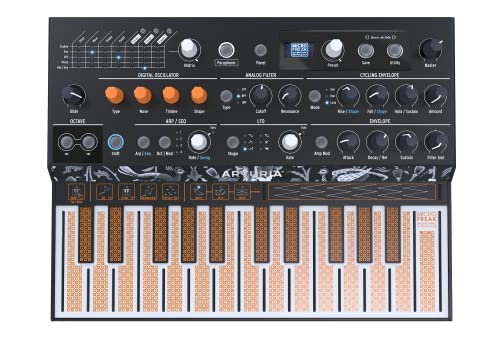 |
Arturia MicroFreak Hybrid Synthesizer | Unique touch keyboard | Wide array of engines | Polyphonic aftertouch | View on Amazon | Read Review |
| Essential Laptop Companion |  |
Akai LPK25 MIDI Controller | Compact, slim profile | Responsive synth action | Simple plug-and-play setup | View on Amazon | Read Review |
| Modern Analog Exploration |  |
Stylophone GENX-2 Analog Synthesizer | Genuine analog synthesis | Built-in analog delay | CV and Gate connectivity | View on Amazon | Read Review |
| Analog Effect Machine |  |
Korg Monotron Delay Synthesizer | Gritty analog sound | Ribbon controller interface | Built-in delay effect | View on Amazon | Read Review |
More Details on Our Top Picks
-
Behringer Phara-O Mini Synthesizer
If you want to start sound design without filling your desk, this miniature synthesizer is your best bet. It packs a surprising amount of sonic depth into a chassis that fits in your palm.
The layout keeps controls simple enough that you will not get lost in menus. Beginners may find the small interface slightly cramped, but the efficiency of the design makes up for the tight quarters.
- Brand Name:Behringer
- Power Source:USB
- Additional Feature:Dedicated compact sound engine
- Additional Feature:Streamlined interface
- Additional Feature:High quality output
-
Akai MPK Mini Play MK3
You get a built-in speaker and a library of internal sounds, making this a complete workstation for the mobile musician. It serves as a MIDI controller that does not require a computer to start making noise.
The keys offer a responsive feel that helps you learn proper technique early on. While the integrated speaker is convenient, it cannot match the fidelity of dedicated studio monitors.
- Brand Name:Akai Professional
- Keyboard Type:25 keys
- Power Source:Battery or USB
- Connection Type:USB MIDI
- Included Software:MPC Beats and sounds
- Additional Feature:Onboard sound engine
- Additional Feature:Eight MPC pads
- Additional Feature:OLED display screen
-
Arturia MiniFreak Hybrid Synthesizer
This machine is a versatile hybrid that combines digital engines with analog filters to create complex, evolving textures. You will appreciate the 6-voice polyphony, which lets you play full chords rather than just single-note lines.
The 37-keybed includes aftertouch, giving you expressive control over your performances. It might feel like a steep learning curve at first, but the depth is worth the effort for any serious student.
- Brand Name:Arturia
- Keyboard Type:37 slim keys
- Voice Count:6 voices
- Connection Type:USB and MIDI
- Included Software:MiniFreak V
- Additional Feature:Analog filter section
- Additional Feature:64-step sequencer
- Additional Feature:Integrated creative effects
-
Behringer Pro VS Mini
Vector synthesis is like painting with four colors at once, and this unit makes that complex process accessible. You can morph between oscillators to create sounds that shift and evolve in real time.
It is small but surprisingly powerful for its size. You should note that the limited button interface requires some menu diving to adjust deeper settings.
- Brand Name:Behringer
- Voice Count:5 voices
- Connection Type:USB
- Additional Feature:Arpeggiator included
- Additional Feature:Portable chassis
- Additional Feature:Real-time morphing controls
-
Stylophone Original Pocket Synthesizer
This is the ultimate entry-level synth for anyone who wants instant, quirky results. You play it using a metal stylus that connects with the keyboard grid to produce classic, buzzy electronic tones.
It is a simple, battery-operated device that lacks professional MIDI features. Treat it as a fun sonic toy rather than a production-grade workstation.
- Brand Name:Stylophone
- Power Source:Batteries
- Additional Feature:Stylus-based interface
- Additional Feature:Built-in speaker
- Additional Feature:Vibrato switch
-
Akai MPK Mini Plus
If you need more room to play, the 37-key layout provides exactly that without losing the portability of the smaller versions. It acts as the bridge between hardware and software, thanks to its extensive MIDI and CV connectivity.
The inclusion of a built-in sequencer allows you to build patterns without touching your computer. It is a workhorse that might overwhelm a complete beginner, but it provides plenty of room to grow.
- Brand Name:Akai Professional
- Keyboard Type:37 mini keys
- Connection Type:USB, MIDI, CV
- Included Software:Native Instruments bundle
- Additional Feature:Eight MPC pads
- Additional Feature:Transport controls
- Additional Feature:Chord and scale modes
-
Arturia MicroFreak Hybrid Synthesizer
The touch-sensitive keyboard behaves differently than standard keys, offering a unique tactile experience for exploring wild digital sounds. You can blend wavetable oscillators with analog filters to craft textures you simply cannot find elsewhere.
This synth is a playground for sound designers who want to break the mold. It is worth remembering that the touch keys take time to master if you are used to traditional piano actions.
- Brand Name:Arturia
- Keyboard Type:25 keys
- Connection Type:USB and MIDI
- Additional Feature:Analog filter section
- Additional Feature:Digital wavetable synthesis
- Additional Feature:Modulation matrix
-
Akai LPK25 MIDI Controller
Sometimes you just need a keyboard that does one thing well, and this streamlined controller fits that description perfectly. It provides a reliable way to input notes into your recording software without any unnecessary distractions.
It lacks pads or knobs, so it is strictly for playing melodies and chords. If you want a minimalist setup, this is a clean, effective choice.
- Brand Name:Akai Professional
- Keyboard Type:25 keys
- Connection Type:USB
- Additional Feature:Built-in arpeggiator
- Additional Feature:Sustain pedal input
- Additional Feature:Portable design
-
Stylophone GENX-2 Analog Synthesizer
This unit updates the classic design with a true analog signal path that sounds significantly richer than the original. You gain access to LFO and filter controls that let you shape your sound in real time.
The CV and Gate outputs allow you to connect this to more expensive studio gear later. It remains a quirky, specialized tool that rewards experimentation over technical precision.
- Brand Name:Stylophone
- Power Source:Batteries or DC
- Connection Type:CV and Gate
- Additional Feature:Built-in speaker
- Additional Feature:Variable filter
- Additional Feature:Adjustable LFO
-
Korg Monotron Delay Synthesizer
This is a pocket-sized powerhouse that uses a ribbon controller to let you slide between pitches like a guitar player. The built-in delay circuit adds a dark, gritty atmosphere to everything you play through it.
It is more of an effect box than a traditional keyboard. You will find it is a fantastic tool for adding character to your existing tracks.
- Brand Name:Korg
- Keyboard Type:Ribbon controller
- Power Source:Batteries
- Additional Feature:Filter cutoff control
- Additional Feature:Internal speaker
- Additional Feature:Headphone output
Frequently Asked Questions
Do I need an external amplifier to hear my synthesizer?
Most synthesizers do not have built-in speakers. You will need to plug in a pair of studio headphones or connect the output to an external speaker system. Ensure you have the right cables, usually 1/4-inch instrument cables, before you set up your workspace.
What is the difference between a synthesizer and a MIDI controller?
A synthesizer generates its own internal sound without needing any other gear. A MIDI controller is a silent keyboard that sends signals to your computer, relying on software instruments to create audio. If you want a standalone instrument, buy a synthesizer.
How much should a beginner expect to spend?
You can find capable entry-level models between $300 and $600. While it is tempting to find the cheapest option, spending a little more often buys you better build quality and a more intuitive layout. Avoid the bargain-bin keyboards that feel like toys, as they rarely hold their value or offer professional sound.
Is it hard to learn how to program sounds?
It is like learning a new language, where you start by picking up a few essential terms first. Most modern synths follow a logical flow of oscillators, filters, and envelopes. If you take it one knob at a time, you will master the basics of sound design in a few weeks.
Can I use a synthesizer for live performance?
Portability is the most important factor for gigging musicians. Look for a lightweight model with a sturdy chassis that can withstand the bumps of travel. You should also ensure the unit has an easy-to-read display so you can quickly switch between your favorite sounds while on stage.

James Wilson is a seasoned product review specialist with a strong focus on coffee grinders and home brewing equipment. With years of hands-on experience testing both manual and electric grinders, he brings practical insights and honest recommendations to help readers make informed decisions. James is passionate about the role grind quality plays in achieving the perfect cup of coffee, and he combines technical knowledge with a user-friendly approach. His reviews are known for their clarity, depth, and reliability, making him a trusted voice for coffee enthusiasts looking to upgrade their daily brewing experience.