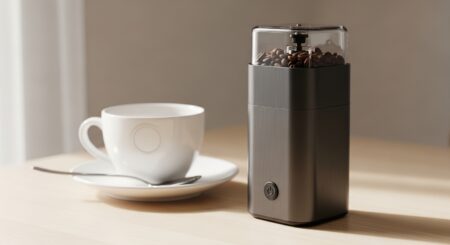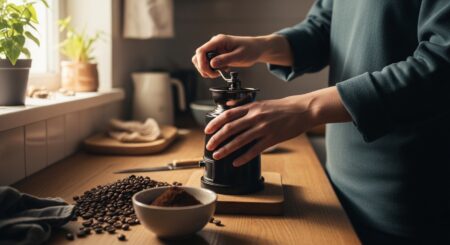

You’re standing there, staring at a bag of whole beans, wondering how to grind coffee beans without a grinder because of course… the grinder is the one thing you don’t have right now, yeah? It’s a bit annoying, like having pasta but no pot. But also, weirdly fixable. You’ve probably got something in your kitchen already that’ll do the job, just not in the neat, Instagram-coffee way.
Let’s figure this out without overthinking it too much.
Why Grinding Coffee Beans Actually Matters (More Than You Think)
So here’s the thing — coffee beans aren’t just stubborn little rocks for no reason. The grind size kinda controls how your coffee tastes. Too coarse, and it’s watery like sad tea. Too fine, and suddenly it’s bitter like you offended it somehow.
According to the National Coffee Association, grind size affects extraction rate, which basically means how quickly water pulls flavor out of the beans. And yeah, that matters more than people casually admit.
If you’re improvising without a grinder, you won’t get perfection, but honestly? You don’t need perfection. You need drinkable.
The Quick Reality Check Before You Start
Let’s be honest for a sec. Grinding coffee beans without a grinder is:
- Messier than expected
- Louder than expected
- Slightly more chaotic than it sounds
But also kinda fun, like DIY cooking when you’re half awake.
What you’re aiming for depends on your brewing method:
| Brewing Method | Ideal Grind |
|---|---|
| French Press | Coarse |
| Drip Coffee | Medium |
| Espresso | Fine |
| Cold Brew | Extra Coarse |
You won’t hit these exactly, but you can get… close-ish.
Method 1: Using a Blender (Probably the Easiest Backup)
If you’ve got a blender, you’re already halfway sorted. It’s basically a chaotic coffee grinder if you use it right.
How to Do It
- Add a small amount of beans (don’t overfill, seriously)
- Use the pulse setting — not continuous blending
- Shake the blender slightly between pulses
- Stop before it turns into dust or uneven chaos
Why This Works (Kind Of)
Blenders use blades instead of burrs, so the grind is uneven. But uneven doesn’t mean unusable. It just means your coffee might taste… interesting.
A study in the Journal of Food Engineering (2017-ish, if I remember right) found that uneven particle sizes lead to inconsistent extraction — which is a fancy way of saying some bits overbrew while others underbrew.
Still drinkable though, promise.
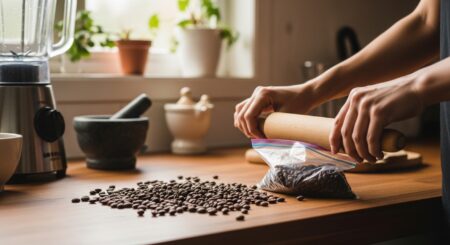
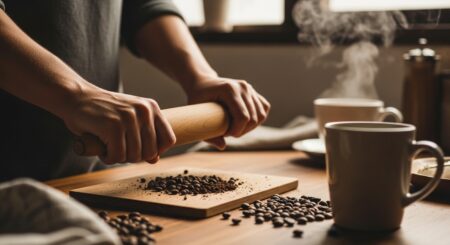
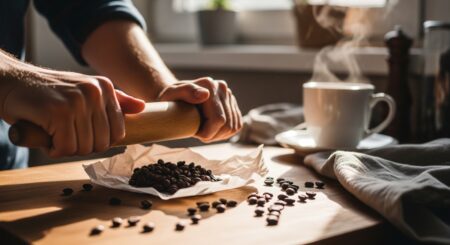
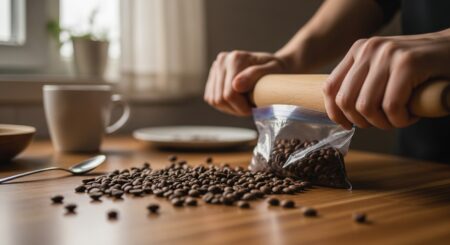
Method 2: The Rolling Pin Trick (Oddly Satisfying)
This one feels a bit like baking, except you’re smashing coffee instead of dough.
What You Need
- Rolling pin (or a sturdy bottle, honestly)
- A zip-lock bag or thick cloth
Steps
- Put beans in the bag
- Lay it flat on a solid surface
- Roll over them like you mean it
- Apply pressure, not rage (well, a little rage is fine)
The Result
You’ll get a coarse grind, perfect-ish for:
- French press
- Cold brew
It won’t be uniform, but it doesn’t need to be.
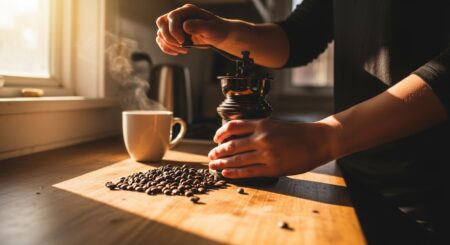
Method 3: Mortar and Pestle (Old School, But Surprisingly Good)
People have been doing this way before electric grinders were a thing, so yeah, it works.
How It Goes
- Add a small batch of beans
- Press down and twist
- Repeat… a lot more than you expect
It’s slower, yeah. But you actually get better control over grind size compared to other DIY methods.
Also, this method is kinda calming? Or maybe that’s just me.
Method 4: Hammer Time (Literally)
Okay, this sounds aggressive, because it is.
Setup
- Beans in a thick bag
- Place on a hard surface (not glass, please)
- Use a hammer, mallet, or even a heavy pan
Execution
- Tap gently first (don’t go full destruction mode immediately)
- Break beans into smaller chunks
- Repeat until you reach desired size
Warning
You will feel like you’re doing something questionable. But it works.
Method 5: Knife Crushing (If You’re Feeling Careful-ish)
This one needs a bit of control and maybe some confidence.
Steps
- Place beans on a cutting board
- Use the flat side of a chef’s knife
- Press down firmly until beans crack
Then you can chop them further if needed.
Not the most efficient method, but it’s there if options are limited.
Comparing the Methods (So You Don’t Overthink It)
| Method | Effort Level | Grind Quality | Best For |
|---|---|---|---|
| Blender | Low | Medium | Drip coffee |
| Rolling Pin | Medium | Coarse | French press |
| Mortar & Pestle | High | Better control | All types |
| Hammer | Medium | Rough | Cold brew |
| Knife | Low | Very rough | Emergency use |
Honestly, pick whatever feels least annoying in the moment.
Small Tricks That Make a Big Difference
Grinding coffee beans without a grinder isn’t just about smashing stuff randomly. A few tiny tweaks can actually improve your results.
1. Work in Small Batches
Too many beans = uneven grind. Always.
2. Sift If You Can
If you’ve got a sieve:
- Shake out finer particles
- Re-grind bigger chunks
Feels extra, but it helps.
3. Don’t Overheat the Beans
Blenders especially can heat things up, which messes with flavor. Pulse, don’t blend continuously.
4. Adjust Brewing Time
Because your grind won’t be perfect:
- Coarser grind → brew longer
- Finer grind → brew shorter
You kinda have to improvise here.
What About Taste? Let’s Be Real
Here’s the honest part nobody sugarcoats enough: your coffee might not taste amazing the first time you try this.
And that’s fine.
You’re working without proper equipment. The goal is:
- Fresh-ish coffee
- Better than pre-ground (usually)
- Good enough to enjoy
In fact, according to data from the Specialty Coffee Association, freshness contributes significantly to perceived flavor quality — even more than perfect grind consistency in some cases.
So yeah, you’re still winning here.
When You Should (Eventually) Just Get a Grinder
Look, this whole “how to grind coffee beans without a grinder” situation is great in a pinch, but not forever.
You might wanna consider a grinder if:
- You drink coffee daily
- You care about flavor consistency
- You’re tired of smashing beans like a caveman
Even a basic manual grinder can make a huge difference.
But until then? You’re doing just fine.
A Slightly Weird Tip That Actually Helps
If your grind is super uneven (which it probably will be), try mixing it before brewing. Like literally stir the ground coffee a bit so finer and coarser particles distribute evenly.
It sounds unnecessary, but it weirdly balances extraction.
I didn’t expect it to work either, but here we are.
Final Thoughts (And Yeah, You Got This)
So now you know how to grind coffee beans without a grinder, and honestly, it’s not as complicated as it seemed five minutes ago when you were staring at those beans like they personally betrayed you.
You’ve got options:
- Blend them
- Smash them
- Roll them
- Crush them like you’re in a cooking show gone slightly off-script
None of these methods are perfect, but they don’t need to be. Coffee’s kinda forgiving like that. A bit messy, a bit uneven, still good enough to start your day.
And next time this happens, you won’t even pause — you’ll just grab a rolling pin or blender and get on with it, like yeah, I know what I’m doing now.
Which, to be fair, you kinda do.